


In the rapidly evolving landscape of the automotive industry, characterized by the surge in Electric Vehicles (EVs) and Advanced Driver Assistance Systems (ADAS), the demand for high-reliability electronic components has never been greater. At the heart of these complex systems are relays—the silent guardians of electrical circuits. Zhejiang Meishuo Electric Technology Co., Ltd., a publicly listed leader in the electromechanical component sector, recognizes that in the automotive world, quality is not just a metric; it is a prerequisite for safety. Our 'Zero-Defect' commitment is not merely a slogan but a rigorous operational philosophy anchored in the IATF 16949 standard.
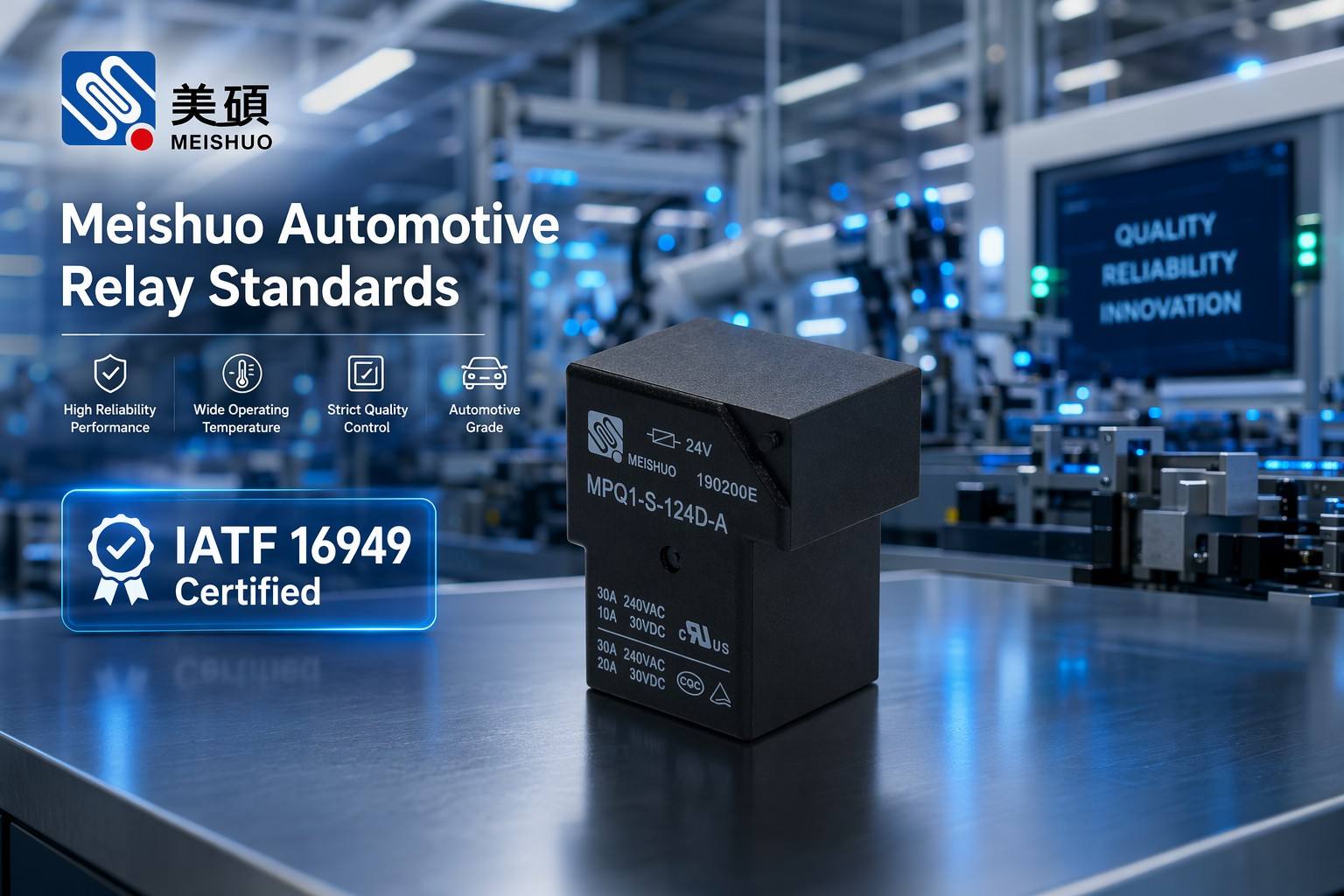
IATF 16949 is the global quality management system standard for the automotive industry. It emphasizes the development of a process-oriented quality management system that provides for continual improvement, defect prevention, and the reduction of variation and waste in the supply chain. At Meishuo, we have integrated IATF 16949 with our existing ISO 9001 foundations to create a robust management ecosystem that governs every facet of our operations.
For a listed company like Meishuo, adhering to these standards is a testament to our corporate responsibility and brand integrity. It ensures that every automotive relay, from the heavy-duty MAD series to the precision-engineered MAT and MAC series, meets the stringent requirements of global OEMs (Original Equipment Manufacturers).
Quality is designed into the product long before the first unit rolls off the assembly line. Our implementation of IATF 16949 begins with Advanced Product Quality Planning (APQP). This structured process ensures that we understand the customer's voice and translate it into technical specifications that prioritize reliability. APQP serves as the roadmap for our development team, guiding them through five distinct phases: planning, product design, process design, product and process validation, and feedback and corrective actions.
A critical component of our R&D phase is the application of Failure Mode and Effects Analysis (FMEA). For our flagship automotive relay series—including the MAD (Miniature Automotive Dual), MAT (Micro Automotive Terminal), and MAC (Micro Automotive Component) series—we conduct exhaustive Design FMEA (DFMEA). We simulate potential failure modes under extreme automotive environments, such as high-temperature engine bays or high-vibration chassis locations. By identifying potential risks early, we optimize the design of contact materials, spring tensions, and housing seals to prevent issues before they occur. This preventative approach is the essence of the IATF 16949 philosophy, shifting the focus from detection to prevention.
Meishuo’s transition to a 'Digital Factory' is a cornerstone of our zero-defect strategy. In our automotive relay production lines, we have deployed a sophisticated Manufacturing Execution System (MES) that provides real-time visibility into the shop floor. This system is the 'digital nervous system' of our production process, ensuring that the principles of IATF 16949 are executed with robotic precision. The integration of the MES system allows for the synchronization of all manufacturing data, including equipment status, material usage, and operator performance.
The MES system enables 100% traceability, which is a fundamental requirement of both ISO 9001 and IATF 16949. Every component used in a MAT series relay, for instance, is logged with a unique identifier. Should a discrepancy arise, we can trace the exact batch of raw materials, the specific machine parameters at the time of assembly (such as contact pressure or laser welding power), and the personnel involved. This level of granular control is essential for the Production Part Approval Process (PPAP) and provides our automotive clients with the transparency they demand. Furthermore, the digitalization of our factory minimizes human error through automated Poka-Yoke (error-proofing) mechanisms. Sensors and AI vision systems check every relay for dimensional accuracy and cosmetic defects at every stage, ensuring that only parts meeting 100% of the quality criteria proceed to the next stage.
Verification is the final gatekeeper of our zero-defect commitment. Meishuo boasts a state-of-the-art testing center that has earned CNAS (China National Accreditation Service for Conformity Assessment) accreditation. This certification signifies that our laboratory operates at an international standard of competence, and our test results are recognized globally by more than 100 countries and regions. Our laboratory is not just a facility for final inspection; it is a vital part of our continuous improvement loop.
Our CNAS laboratory is equipped to perform a comprehensive suite of automotive-grade tests that simulate the harshest conditions on the road. For the MAC series relays, which are often used in critical lighting and signal systems, we conduct rigorous electrical endurance tests involving millions of cycles. We also perform thermal shock cycling—exposing the relays to rapid temperature changes from -40°C to +125°C—to ensure the integrity of the plastic housing and the internal seals. Vibration and mechanical shock tests are performed to ensure that the MAD series can withstand the rigors of engine-mounted applications. We also utilize Statistical Process Control (SPC) to monitor production stability in real-time and Measurement Systems Analysis (MSA) to ensure the accuracy and repeatability of our testing equipment. By subjecting our relays to conditions far exceeding normal operating parameters, we ensure that they provide unwavering performance throughout the vehicle's entire lifespan.
IATF 16949 extends beyond our factory walls. We work closely with our suppliers to ensure they also adhere to high-quality standards, fostering a culture of mutual improvement. Our logistics and delivery processes are optimized to prevent contamination or damage during transit, ensuring that the MAD, MAT, and MAC relays arrive at our customers' facilities in the same pristine condition they left our production line.
As Zhejiang Meishuo Electric Technology Co., Ltd. continues to expand its footprint in the global automotive market, our commitment to IATF 16949 remains the bedrock of our growth. By combining the rigor of international standards with the innovation of a digitalized factory and the precision of CNAS-accredited testing, we deliver more than just relays—we deliver confidence. Our zero-defect commitment is our promise to the automotive industry that Meishuo relays are, and will always be, the benchmark for reliability in the era of intelligent mobility.

 Chat Oline