


MPR-S-112-A is the focus of this week's corporate technology feature on a question becoming increasingly important to EV infrastructure developers: how can charging systems become more flexible as vehicles, buildings, batteries and the grid begin to exchange power in both directions?
EV charging has traditionally been designed as a one-way process. Electricity flows from the grid to the vehicle, the vehicle charges, and the session ends. That model is changing. Driivz's 2026 EV charging outlook identifies AI-assisted energy management, bidirectional charging, interoperability and charging-as-a-service as important directions for the charging ecosystem. These developments point to a more coordinated role for charging infrastructure: not simply delivering energy, but managing when, where and how energy moves.
Bidirectional charging introduces a new operating requirement. A charging system may need to connect, isolate, or transfer power under different operating states while maintaining clear electrical separation between control logic and the load circuit. The switching element therefore becomes part of a broader system architecture that includes protection, sensing, thermal management, firmware and communication protocols.
For designers, the objective is not to treat a relay as an isolated component. The relay must be evaluated as part of the complete power path, including inrush conditions, switching frequency, load type, enclosure temperature, PCB layout, creepage and clearance, and the intended protection strategy.
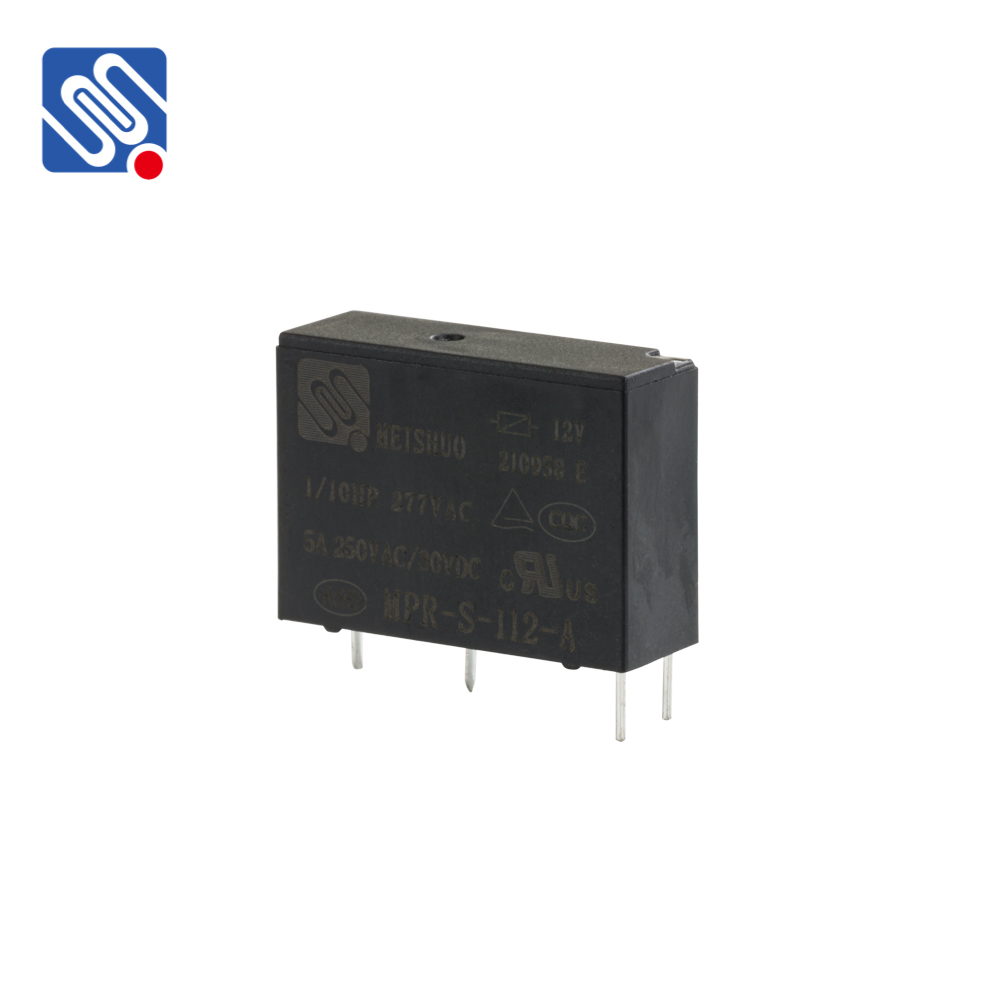
The MPR-S-112-A shown in this feature is a compact electromechanical relay with visible contact markings and PCB terminals. Its form factor makes it relevant to engineers assessing switching arrangements in space-constrained control boards, auxiliary power circuits and charging-related equipment. Final suitability must always be confirmed against the application load, electrical category, duty cycle, ambient conditions and the manufacturer's technical documentation.
In a bidirectional EV charging system, a relay may be used in a control or auxiliary switching stage rather than as the sole protection device. A robust design separates switching, isolation and fault interruption responsibilities. This approach allows the relay to perform its intended control function while fuses, contactors, interlocks and monitoring circuits address the other safety requirements of the system.
This architecture is especially relevant to wallboxes, energy gateways and power-management modules that coordinate EV charging with photovoltaic generation or stationary energy storage. The relay's value is not a marketing label attached to a single component; it is the repeatable switching behavior it contributes to a properly engineered system.
The move toward V2G and V2H creates several practical design priorities.
First, the control system must distinguish between charging, standby, discharge and fault states. Switching logic should be coordinated with voltage and current measurements so that a relay is not asked to interrupt an unsuitable condition. Second, the system must manage transitions. A clean transition between operating modes requires timing, interlocking and, where appropriate, pre-charge or discharge routines. Third, the enclosure and PCB must support thermal stability over the expected duty cycle. Component selection cannot be separated from heat dissipation and spacing decisions.
The fourth priority is serviceability. Commercial charging operators increasingly need equipment that can be diagnosed remotely and maintained predictably. The Driivz outlook highlights the role of intelligent energy management in improving uptime and coordinating multiple energy sources. That software layer still depends on reliable physical switching underneath it. A relay that is selected with a clear understanding of its electrical and mechanical limits helps engineers build a more transparent maintenance strategy.
Reliability in EV charging is cumulative. It comes from the interaction of suitable components, controlled manufacturing, validated assembly, protection design and software behavior. For a relay supplier, this means supporting customers with clear documentation, stable production processes and application guidance rather than presenting a component as a universal solution.
Meishuo Technology approaches the MPR-S-112-A as part of this system-level conversation. The product image preserves the relay's original housing, markings and terminals; the application discussion around it is intentionally broader than a single unsupported performance claim. Engineers should use the published datasheet and qualification records to verify the exact model variant before design release.
The next stage of EV charging will likely be defined by coordination. Charging networks, vehicles, batteries, renewable generation and building loads will increasingly be managed as connected assets. AI may optimize schedules and site power, while bidirectional functions create new operating modes and commercial models. Interoperability and predictable service will become as important as peak charging speed.
In that environment, compact switching components remain essential. They provide the physical actions that allow a digital energy strategy to become a real electrical sequence. The MPR-S-112-A represents one such building block for engineers evaluating relay-based control architectures in EV charging and related power-management equipment.
For product selection, contact Meishuo Technology for the relevant datasheet, model variant, coil option, load category and application review before final qualification.

 Chat Oline